Celestial Mechanics
General relativity has been a cornerstone of modern physics, providing a remarkably accurate description of gravitational phenomena, especially in strong-field regimes such as those found near black holes. One of the most compelling confirmations of general relativity has come from the study of S-stars that orbit the supermassive black hole at the center of our Galaxy, Sagittarius A*. These stars, particularly the S2 star, have been observed with exceptional precision, allowing astronomers to test the predictions of general relativity in extreme environments. The precise tracking of these stellar orbits has not only confirmed the existence of a supermassive black hole but also offered a unique laboratory for probing the effects of gravity. Looking ahead, the Gaia mission is expected to revolutionize our understanding of Milky Way by providing even more precise measurements of these stellar orbits. Future work will use Gaia’s astrometric accuracy to further test general relativity and explore new physics, such as the potential influence of dark matter and alternative theories of gravity in the strong gravitational fields near Sagittarius A*.
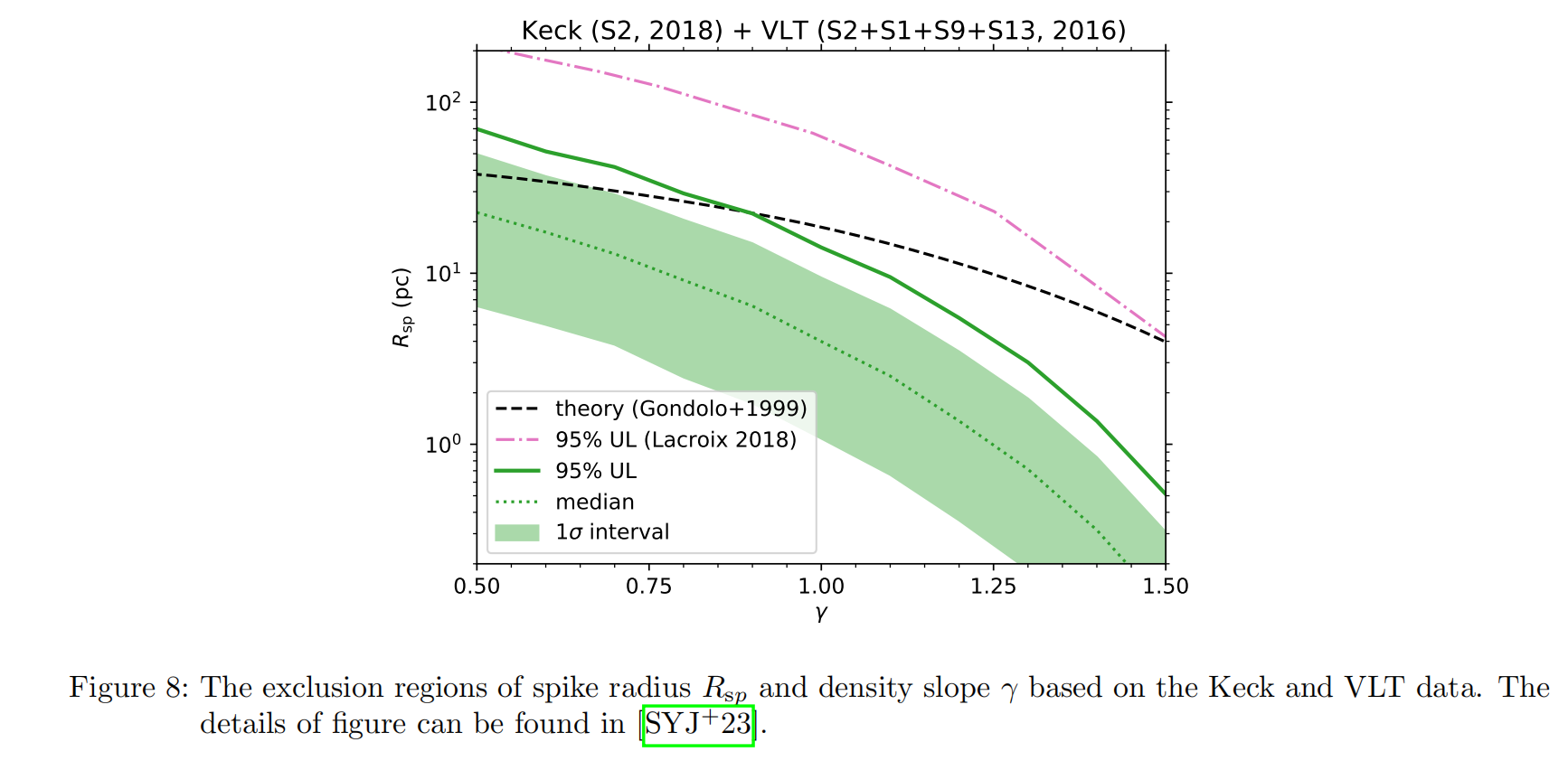
The interaction between this Sagittarius A* and dark matter has sparked ongoing debates regarding the DM density profile in the innermost region of the Galaxy, a crucial factor for indirect DM detection. Among the theoretical models proposed, the spike profile by Gondolo and Silk (1999) is widely considered. In this context, we examine the DM spike profile1 using updated data from the Keck and VLT telescopes, focusing on how such an extended mass component might influence the orbits of S-stars near the Sagittarius A*. By analyzing the generalized NFW spike profile, we find that an initial slope of $\gamma > 0.92$ is excluded at the 95\% confidence level, which challenges the Gondolo and Silk spike model. For the Einasto spike, we rule out a spike radius larger than 21.5 pc. As shown in Fig 8, constraints from the VLT/GRAVITY upper limits are projected, indicating that while the Gondolo and Silk NFW spike is well constrained, an NFW spike with a weak annihilation cusp may still be viable.
By using similar skills, we have also tested the ultralight scalar dark matter2, which has been hypothesized to form a cloud surrounding the Sagittarius A*. With increasingly precise observations of stellar kinematics around the Sagittarius A*, subtle effects from such a dark matter cloud, including gravitational perturbations and direct interactions with ordinary matter, may become detectable. We search for possible evidence of this scalar cloud by analyzing the accurate orbital measurements of the S2 star around Sgr A*. By solving the first-order Post-Newtonian equations and considering the extended mass distribution of the scalar cloud alongside additional couplings via Higgs-portal or photon-portal interactions, we find that the astrometric and spectroscopic data for the S2 star are consistent with a point-like mass for Sgr A*. This leads to the most stringent upper limits on the extended mass and coupling strength of the scalar cloud for the scalar mass window between $3.2\times 10^{-19}$~eV and $1.6\times 10^{-18}$~eV.
Collectively, these investigations highlight the potential and limitations of current observational data in constraining both the DM spike profile and the existence of an ultralight scalar dark matter cloud in the vicinity of the Galactic center.
-
Zhao-Qiang Shen, Guan-Wen Yuan, Cheng-Zi Jiang, Yue-Lin Sming Tsai, Qiang Yuan, and Yi-Zhong Fan.Exploring dark matter spike distribution around the Galactic centre with stellar orbits. Mon. Not. Roy.Astron. Soc., 527(2):3196–3207, 2023. ↩
-
Guan-Wen Yuan, Zhao-Qiang Shen, Yue-Lin Sming Tsai, Qiang Yuan, and Yi-Zhong Fan. Constraining ultralight bosonic dark matter with Keck observations of S2’s orbit and kinematics. Phys. Rev. D,106(10):103024, 2022. ↩